
What the ICMR-INDIAB study measured
If you search for diabetes in India state wise, the most complete answer comes from the ICMR-INDIAB study, led by the Indian Council of Medical Research. Its national report was published in The Lancet Diabetes & Endocrinology in June 2023. It covered all 28 states, two union territories and the National Capital Territory of Delhi.
The survey was done in phases and reached 113,043 adults aged 20 and above. About 33,500 lived in urban areas and 79,500 in rural areas, with equal numbers of men and women. Diabetes and prediabetes were defined using WHO criteria. So these figures come from blood tests on a representative sample, not from what people said they had been told.
- Adults with diabetes in India
- 11.4%, about 101 million (ICMR-INDIAB, 2023)
- Adults with prediabetes in India
- 15.3%, about 136 million (ICMR-INDIAB, 2023)
- Adults surveyed
- 113,043 across 31 states and UTs
For a wider view of how many Indians are screened for diabetes, blood pressure and other conditions, see our page on key numbers for preventive health screening in India.
The state-wise spread: a five-fold gap
The national average hides very different realities. State-wise weighted diabetes prevalence ranged from 4.8% in Uttar Pradesh to 26.4% in Goa, more than a five-fold gap. Prediabetes varied in a similar way, from 6.8% in Mizoram to 31.3% in Sikkim.
- Highest diabetes prevalence
- Goa, 26.4%
- Lowest diabetes prevalence
- Uttar Pradesh, 4.8%
- Highest prediabetes prevalence
- Sikkim, 31.3%
- Lowest prediabetes prevalence
- Mizoram, 6.8%
The study also found a clear urban–rural pattern. Every metabolic condition it measured was more common in urban areas, except prediabetes, which was more common in rural India. That one exception matters a great deal for planning, because rural India is where screening and follow-up are hardest to organise.
Why a low-diabetes state is not a low-risk state
For decision-makers, the most useful finding is not which state tops the table. It is the ratio of diabetes to prediabetes. Eight states had two or more people with prediabetes for every person with diabetes: Arunachal Pradesh, Bihar, Madhya Pradesh, Meghalaya, Chhattisgarh, Rajasthan, Sikkim and Uttar Pradesh. The authors noted that most of these states rank lower on the human development index.
Writing in the National Medical Journal of India, the study leaders noted that states with high diabetes tended to have lower prediabetes. This suggests the epidemic may be levelling off there. The other side is a warning: states with low diabetes but high prediabetes can expect large increases in the years ahead.
Population size raises the stakes. The same commentary pointed out that Uttar Pradesh had an estimated 235.6 million people in 2023. Even a small rise in prevalence there means a very large number of new patients. In an interview with Down To Earth, the study's lead author said that without intervention, about 60% of people with prediabetes would go on to develop diabetes.
State figures are averages. Districts, cities and communities within a state can differ sharply. And because the survey was done in phases, some states were measured several years before others. Use the state table as a starting point for local screening, not a replacement for it.
What the data means for different decision-makers
High-prevalence states
Where a quarter of adults already have diabetes, the main task is keeping it under control and catching complications early. That means regular sugar and HbA1c checks, blood pressure, kidney function, eye and foot checks, and a reliable route back to a doctor.
Low-prevalence, high-prediabetes states
Here the opportunity is prevention. Finding people with raised sugar before diabetes sets in gives them time to change their diet, activity and weight, guided by a doctor. Repeat screening matters, because one normal result says little about next year.
Employers, CSR teams and hospitals
- CSR and HR heads can use their state's ratio to decide whether a programme should focus on finding new cases or on follow-up for known ones.
- Hospitals and clinics in high-prevalence areas can expect more patients who need long-term monitoring, and should plan OPD capacity for them.
- District officials can compare screening numbers with the expected burden in their state to see how many people are still being missed.
Our summary of India's preventive health screening data can help you work out the size of that gap.
What screening can do about it
India already has a national programme for this. Under the National Programme for Prevention and Control of Non-Communicable Diseases, people aged 30 and above are screened at more than 177,000 Ayushman Arogya Mandirs. Health workers use the Community-Based Assessment Checklist, according to the Ministry of Health and Family Welfare.
Screening does not diagnose. It finds people who need a closer look. A practical screening pathway looks like this:
- Use a risk checklist and a blood sugar test to flag people with raised readings.
- Refer anyone flagged to a doctor, who decides on confirmatory tests and treatment.
- Record results against the person's health ID so the next visit can be compared with this one.
- Re-screen at regular intervals, especially in states and groups where prediabetes is common.
- Track the numbers: how many were screened, how many were flagged, how many saw a doctor.
The weakest link is usually step two. A flagged reading that never reaches a doctor does no good. That is why the referral and follow-up loop matters as much as the test itself. Read more about how this works at Ayushman Arogya Mandirs.
Where Health ATMs fit in
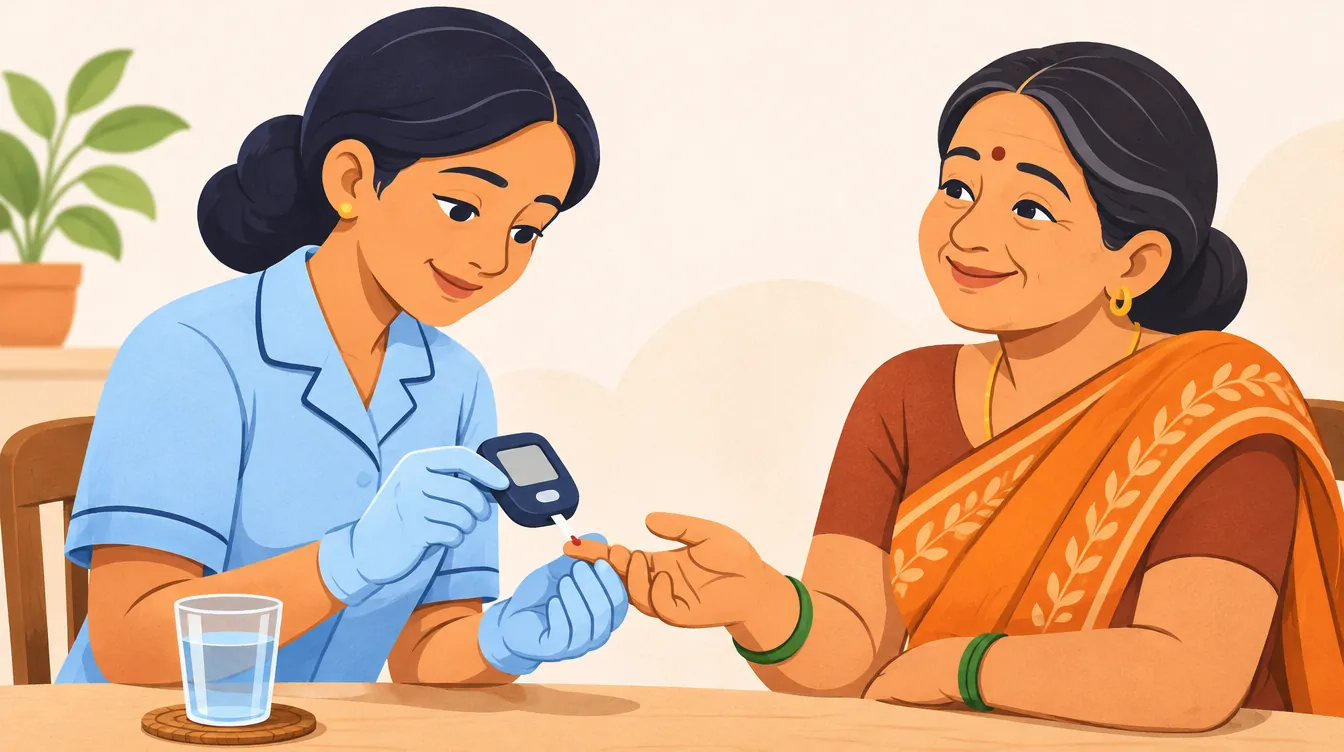
A health kiosk can take screening to places far from a laboratory: PHCs, workplaces, schools, pharmacies and community centres. Cloudspital makes AI Health ATMs at its own facility in Greater Noida, with models running from 48 to 170 tests and parameters. A model such as the CPL-HA-04 Health ATM with HbA1c adds a longer-term measure of blood sugar.
The kiosks screen and measure; they do not diagnose. A doctor reviews results on video and can issue an e-prescription. Reports print at the kiosk and reach people by SMS and WhatsApp. Records can link to ABHA, which supports the follow-up loop described above. Kiosks work offline and sync later, and voice guidance in English, Hindi and regional languages helps first-time users.
Before you plan a programme, compare your state's figures with our preventive health screening numbers for India. Then book a demo or request a written quote for the setting you have in mind.
Sources
- Metabolic non-communicable disease health report of India: the ICMR-INDIAB national cross-sectional study (ICMR-INDIAB-17), The Lancet Diabetes & Endocrinology
- Lessons learnt from the ICMR–INDIAB study, The National Medical Journal of India
- India's diabetes epidemic just got more grim; Lancet report reveals why, Down To Earth
- Steps taken to reduce obesity: Ministry of Health and Family Welfare, Press Information Bureau, Government of India
How this article was made: drafted with AI assistance, checked against the sources above, and read and approved by the Cloudspital team before publishing. It is general information, not medical advice.