

The short answer: accurate for screening, not a replacement for a lab
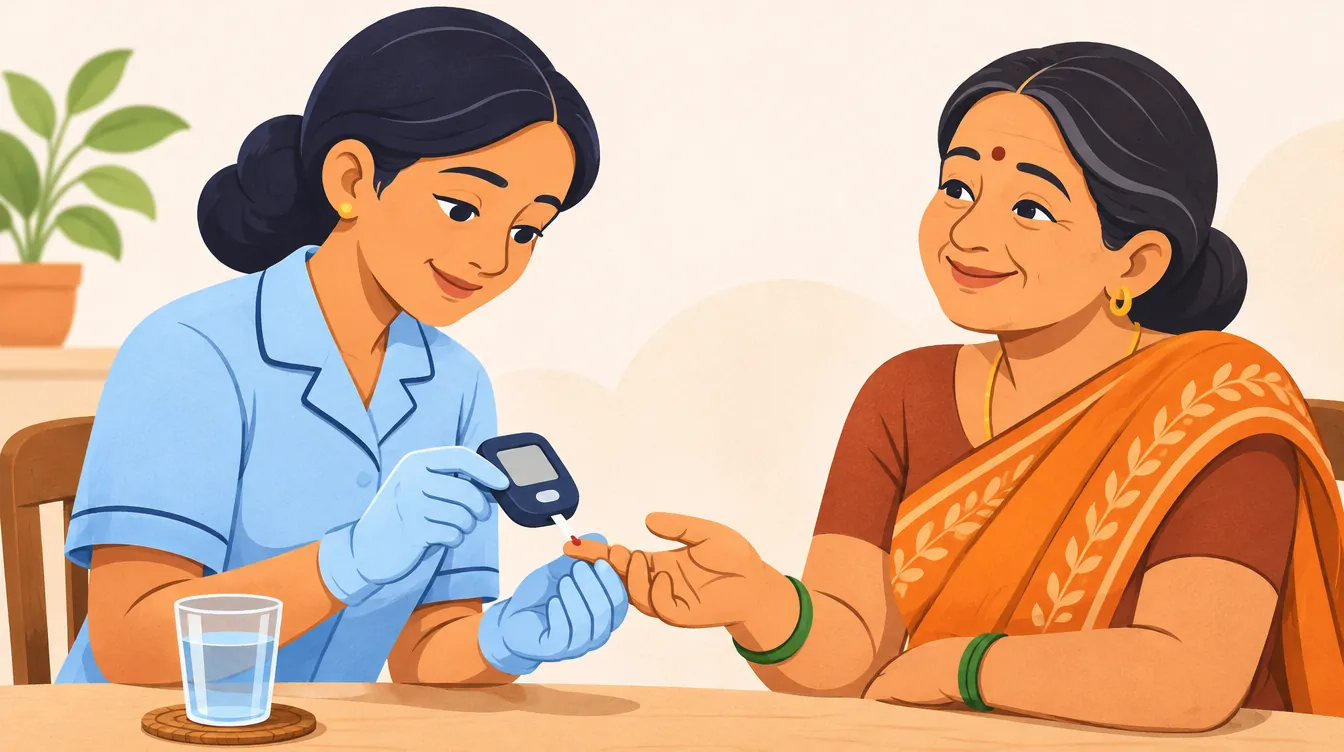
Buyers ask us 'is a Health ATM accurate?' more than almost any other question, and it deserves a straight answer. A health kiosk brings point-of-care devices together in one guided station: a blood pressure monitor, a glucometer, a pulse oximeter, analysers for finger-prick blood tests and more. If you are new to the idea, our guide to what a Health ATM is and how it is put together explains the basics.
When people talk about accuracy, they usually mean two things. Agreement is how close a reading is to a reference method, such as a hospital lab analyser. Repeatability is whether the same person gets a similar reading when the test is done again. Good point-of-care devices can do well on both, but they are built for screening: finding people who need a closer look. They do not replace the lab tests a doctor orders to confirm a diagnosis.
A kiosk screens and measures. A doctor reviews the results and decides what they mean. That split is what makes a kiosk safe to use.
What decides how accurate a reading is
No kiosk is simply 'accurate' or 'inaccurate'. Each test has its own accuracy, and four things shape it.
- The device itself. Some devices have been checked against reference methods in clinical studies, and some have not. That evidence varies from device model to device model.
- The method. A finger-prick (capillary) sample, a venous sample drawn in a lab and a non-invasive optical sensor can all give slightly different values for the same person.
- How the test is done. Posture, movement, cuff size, a clean and dry fingertip and the order of steps all matter.
- Upkeep. Test strips and cartridges stored or used past their dates, skipped device checks and worn cuffs all make results drift.
Cuff size shows how much technique matters. In a 2022 study of automated blood pressure monitors, reported by the American Heart Association, a cuff that was too small gave falsely high readings in 39% of participants. A cuff that was too large missed 22% of people who did have hypertension.
- Falsely high BP with a too-small cuff
- 39% of participants (2022 study, AHA News)
- Hypertension missed with a too-large cuff
- 22% of those who had it (2022 study, AHA News)
- Hidden low oxygen missed by pulse oximetry
- Nearly 3 times as often in Black as in White patients (NEJM, 2020)
Test by test: what the evidence says
Blood pressure
Automated monitors are the norm in primary care. The WHO HEARTS technical package advises using clinically validated automated blood pressure devices in primary care. Validation is done once for each device model and shows that the model measures accurately in real patients. On the day of the test, a cuff that fits, a supported arm and a few quiet minutes before the reading matter just as much.
Blood sugar and HbA1c
Finger-prick tests are well studied. A field study in India compared two point-of-care HbA1c tests with the lab reference method in 114 patients, at a medical college OPD in Bhopal and a rural primary health centre in Madhya Pradesh. It found the point-of-care tests to be an acceptable alternative for assessing blood sugar control. Even so, a diabetes diagnosis is confirmed by a doctor, usually with lab tests.
Oxygen saturation
Pulse oximeters are useful, but they have known limits. A 2020 study in the New England Journal of Medicine found that Black patients had nearly three times as many episodes of low oxygen that pulse oximetry missed as White patients did. Treat a 'normal' oxygen reading together with how the person feels, not on its own.
Blood counts, organ function and other analysers
Higher-end kiosks add analysers for tests such as a complete blood count, liver and kidney function and sickle cell screening. These work like compact lab instruments, so their accuracy depends on good sample handling, consumables used within date and regular checks. Our page on Health ATM tests and parameters shows which method each test uses.
AI face scans
Contactless face scans estimate wellness indices from a short video of the face. Read them as a prompt for a conversation or a follow-up test. They are not clinical measurements and they are not a diagnosis.
Where kiosk readings can mislead, and how good sites prevent it
Most poor readings come from how the test was done, not from a faulty device. A well-run site builds simple habits into the day:
- Seat people and let them rest before the blood pressure check, with feet flat and arm supported.
- Repeat any reading that looks unusual before it goes on the report.
- Run the kiosk's device check at the start of each day and log the results.
- Store test strips and cartridges as the maker says, and remove any that are past their date.
- Have a trained operator nearby for first-time users, older people and anyone who is unsure.
- Make sure every flagged result reaches a doctor rather than ending with a printout.
For more on where a kiosk fits next to a clinic visit, see our comparison of a Health ATM and a traditional check-up.
Screen first, then confirm: what should happen after an unusual result
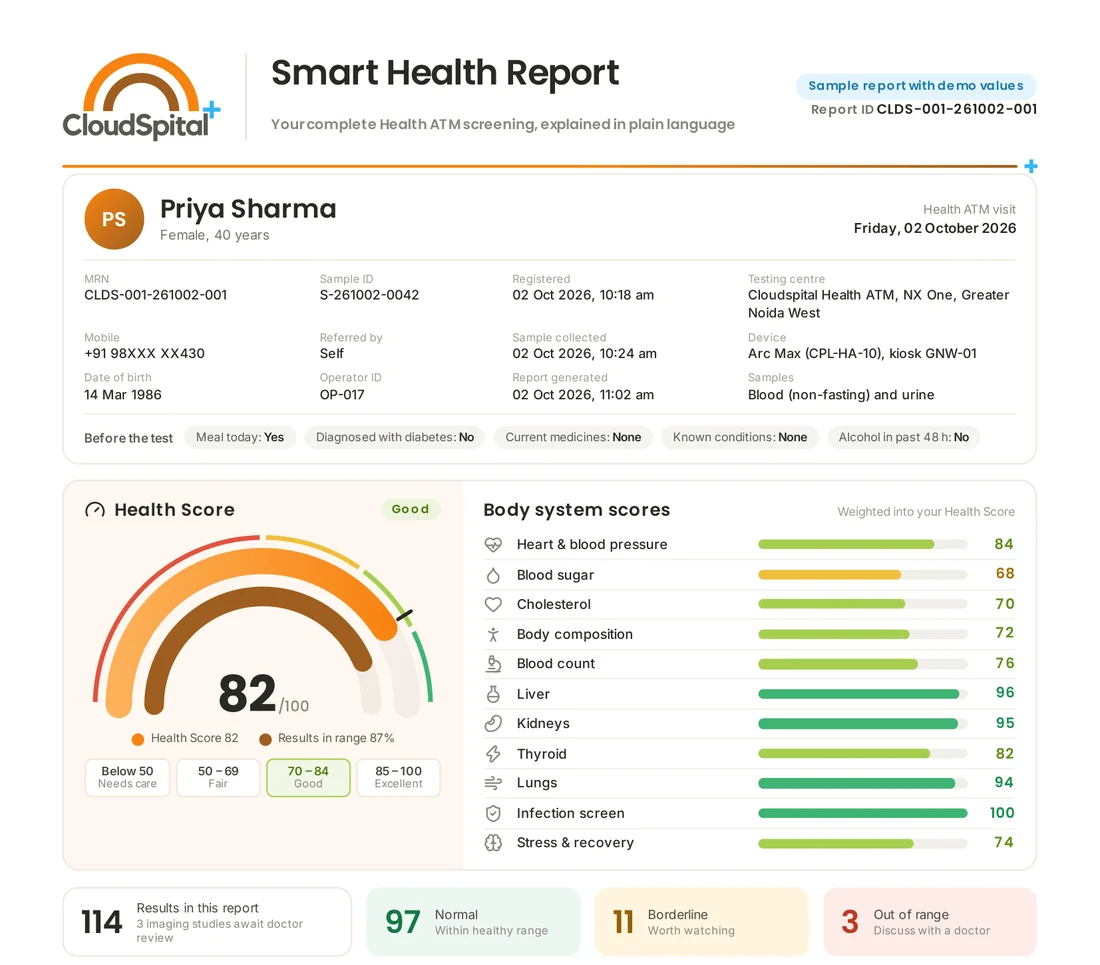
The real value of a kiosk is what happens next. A high blood pressure or sugar reading should lead to a doctor's review. That review may lead to repeat readings on other days, lab tests or a referral. An unusual result is a reason to follow up, not a diagnosis, and a normal result does not rule out a condition if you have symptoms.
If someone has chest pain, severe breathlessness, signs of a stroke or fainting, do not wait for a kiosk report. Call 112 or 108 at once.
Questions to ask any Health ATM supplier about accuracy
- Which device sits behind each test, and is it finger-prick, venous or non-invasive?
- What evidence compares each device model with a lab reference method?
- Which tests are screening estimates or wellness indices, and how does the report label them?
- What daily checks and quality controls does the kiosk run, and who reviews them?
- How are consumables supplied, stored and tracked for expiry?
- Who reviews flagged results, and how quickly do they reach a doctor?
Clear answers to these questions matter more than a long test list. Our explainer on how a Health ATM works, from sample to report is a useful place to start before you talk to suppliers.
How Cloudspital approaches accuracy
Cloudspital makes its Health ATMs at its own facility in Greater Noida. The CPL-HA range runs from 48 to 170 tests and parameters. The flagship Arc Max brings 22 medical devices into one kiosk, with tests including a CBC with 3-part differential, liver and kidney function and sickle cell screening. Each kiosk is built to screen, and a doctor reviews results on video and can issue an e-prescription. The 30-second AI face scan uses clinically validated technology, and its 28 readings are wellness indices, not a diagnosis.
Upkeep matters for accuracy too. Every kiosk comes with a 5-year comprehensive on-site warranty, 95% quarterly uptime, a 24-hour response and spares for 7 years. You can compare every model on our Health ATM products page, where the catalogue and brochures are free to download. When you are ready, book a demo or request a written quote and ask us the questions above.
Sources
- Racial Bias in Pulse Oximetry Measurement, New England Journal of Medicine
- When it comes to accurate blood pressure readings, cuff size matters, American Heart Association News
- Use of clinically validated BP devices (WHO HEARTS), World Health Organization, South-East Asia Region
- Diagnostic Accuracy of Point-of-Care Tests Measuring Glycosylated Haemoglobin (HbA1c) for Glycemic Control: A Field Study in India, PubMed Central (NCBI)
How this article was made: drafted with AI assistance, checked against the sources above, and read and approved by the Cloudspital team before publishing. It is general information, not medical advice.