

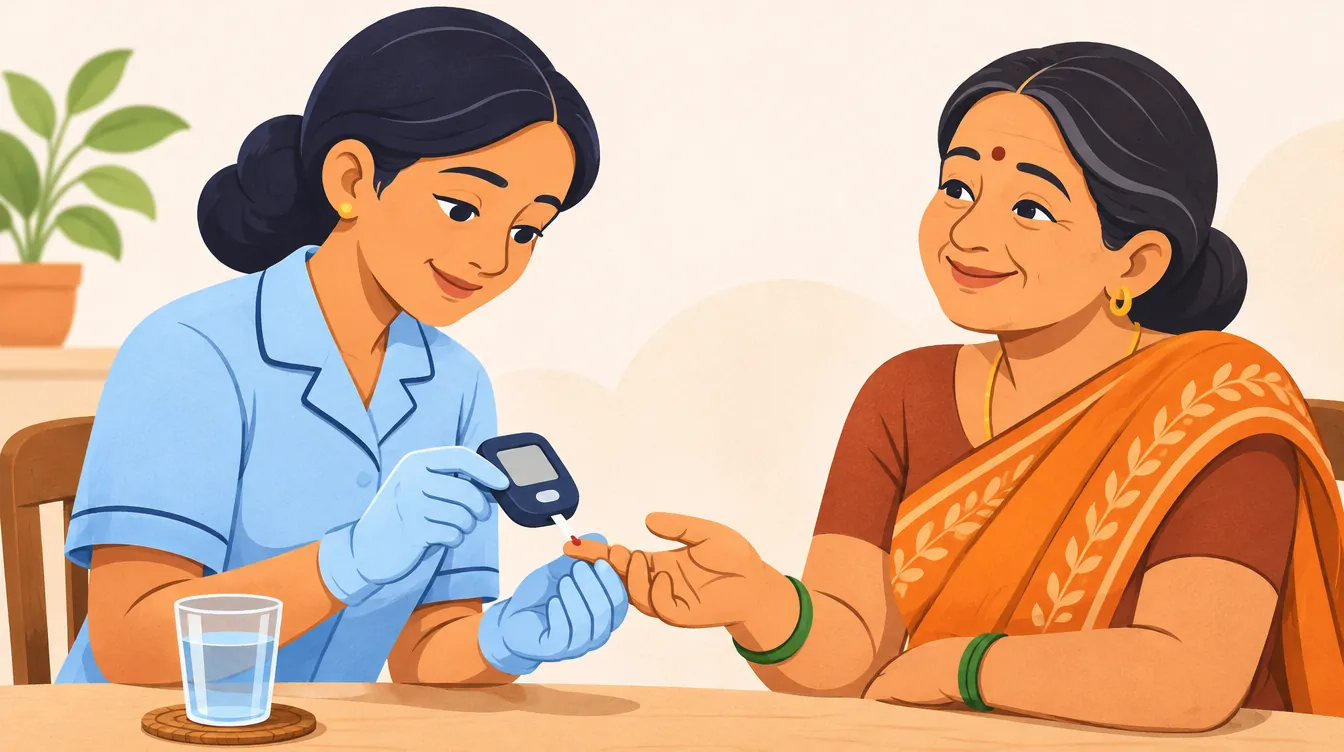
What an HbA1c test measures
Sugar in the blood attaches to haemoglobin, the protein in red blood cells that carries oxygen. The more sugar there has been in your blood, the more haemoglobin becomes "glycated". An HbA1c test reports, as a percentage, how much of your haemoglobin is carrying glucose.
Red blood cells live for a few months. According to WHO guidance, this means the result reflects your average blood glucose over roughly the previous 8 to 12 weeks. A random sugar check is different. It shows your glucose at one moment, and the reading changes with your last meal, stress or illness.
That longer view is what makes an HbA1c test kiosk useful for screening. One small drop of blood from a fingertip gives a steadier picture than a single sugar reading. People generally do not need to fast for HbA1c on its own.
Why HbA1c screening matters in India
The ICMR-INDIAB-17 study was published in The Lancet Diabetes & Endocrinology in 2023. It estimated that about 10.1 crore people in India are living with diabetes and another 13.6 crore have prediabetes. The authors noted that these figures are much higher than earlier estimates.
- People with diabetes in India
- 10.1 crore (ICMR-INDIAB-17, 2023)
- People with prediabetes in India
- 13.6 crore (ICMR-INDIAB-17, 2023)
- HbA1c cut point for diabetes
- 6.5% (WHO; ICMR)
Raised blood sugar often causes no clear symptoms for years, so many people only find out when they are tested. At the prediabetes stage, changes to diet, activity and weight can make a real difference. ICMR's standard treatment workflow for type 2 diabetes advises that people with prediabetes be tested every year.
District health teams, CSR programmes and employers face a practical question: how to test large numbers of people in places they already visit. These include PHCs, workplaces, pharmacies and community centres, so people don't have to travel to a laboratory.
What HbA1c results generally mean
ICMR's standard treatment workflow for type 2 diabetes uses the HbA1c ranges below. They are in line with the WHO cut point of 6.5%.
- Below 5.7%: below the prediabetes range.
- 5.7% to 6.4%: the prediabetes range. ICMR advises yearly testing.
- 6.5% or above: the diabetes range. A doctor needs to review the result and decide on confirmation and next steps.
A WHO consultation report also notes the view of an international expert committee. The committee considered people with an HbA1c between 6.0% and 6.5% to be at particularly high risk and suitable for diabetes prevention efforts.
These are general screening ranges, not personal treatment targets. If you already have diabetes, your doctor will set an HbA1c goal that suits you.
What a finger-prick result can and cannot show
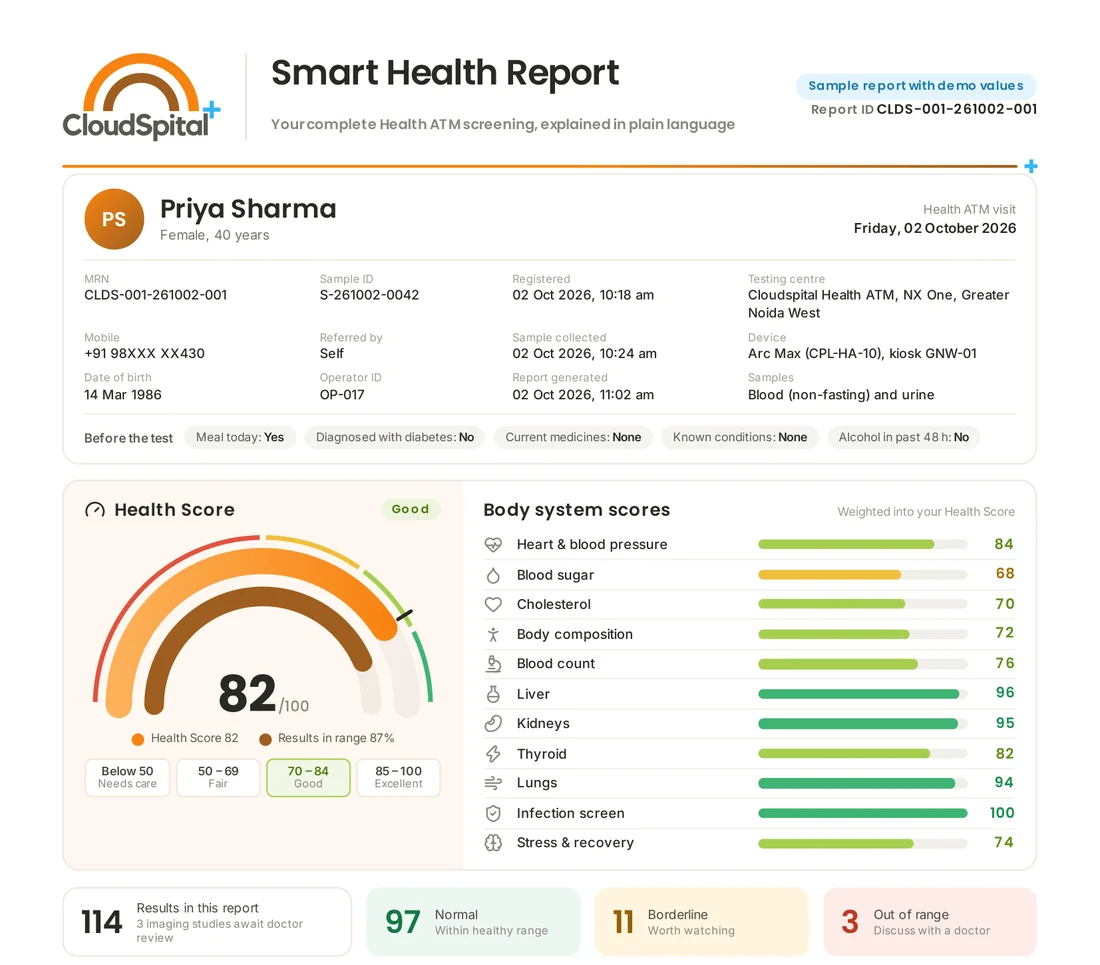
WHO says HbA1c can be used to diagnose diabetes only when three conditions are met. Strict quality assurance must be in place. The test method must be standardised to international reference values. No condition can be present that stops HbA1c being measured accurately. That is why a kiosk reading is a screening result. It flags who needs attention, and a doctor decides whether to repeat the test or confirm it with laboratory tests.
Anaemia and other factors
Anaemia is a widespread concern in India, and it matters here. A clinical laboratory study published in Cureus found that anaemia can be linked to both falsely high and falsely low HbA1c results. The study advised caution when reading HbA1c results in people with anaemia. Tell the reviewing doctor if you have anaemia, a known blood disorder, recent blood loss or a transfusion, or if you are pregnant.
How point-of-care testing compares with a laboratory
An Indian study of 121 participants compared a point-of-care HbA1c device with the laboratory HPLC method. Its authors concluded that the device offered a practical option for managing diabetes in India, especially in primary care and remote areas. Accuracy in daily use still depends on correct sampling, calibration and routine quality checks.
When to see a doctor
- Your HbA1c is 5.7% or above, even if you feel well.
- You have symptoms such as frequent urination, unusual thirst, unexplained weight loss, slow-healing wounds or blurred vision, whatever the reading.
- You already have diabetes and your result is higher than the goal your doctor set.
- You have anaemia or a blood disorder, and the result does not match how you feel or your earlier tests.
Call 112 or 108 straight away in an emergency, such as very high sugar with confusion, drowsiness, vomiting or difficulty breathing. Do not change or stop any medicine because of a kiosk reading. Speak to your doctor first.
How a Health ATM runs an HbA1c test
On a Cloudspital Health ATM, HbA1c is part of a wider check-up rather than a stand-alone test. A typical visit runs like this (see how a Health ATM works for more detail):
- The person registers at the kiosk, with voice guidance in English, Hindi or a regional language. The record can be linked to their ABHA.
- A small finger-prick blood sample is collected for the HbA1c test.
- Other measurements, such as blood pressure, weight and height, are taken in the same visit.
- The report prints at the kiosk and is also sent to the person by SMS and WhatsApp.
- A doctor reviews the results on video and can issue an e-prescription or advise further tests.
- Results are stored in cloud records. If the internet connection drops, the kiosk keeps working offline and syncs later.
The CPL-HA-04 Health ATM with HbA1c and ENT camera runs 60 tests and parameters. The CPL-HA range has 10 models, running from 48 to 170 tests. You can check which models include HbA1c in the full list of Health ATM tests and parameters.
Data is hosted in India and aligned with the DPDP Act 2023. To learn how records connect to a person's health ID, see our page on ABHA integration.
Planning HbA1c screening at your site
Before you add HbA1c screening to a PHC, workplace or pharmacy, work through a few practical questions:
- Who will you screen? The usual focus is adults at higher risk, such as people with a family history of diabetes, excess weight or high blood pressure.
- What happens after a high result? Agree a referral path to a doctor, PHC or hospital before you start.
- How many people a day? Daily volume affects the consumables, staffing and model you need.
- Who runs the kiosk? Plan operator training for sample collection and quality checks.
- How will records flow? Decide how reports will link to ABHA and to your programme dashboard.
Your answers will also shape what a deployment involves. To discuss your site, you can see the CPL-HA-04 in a demo or ask for a written quote through book a demo or request a quote.
Sources
- Metabolic non-communicable disease health report of India: the ICMR-INDIAB national cross-sectional study (ICMR-INDIAB-17), The Lancet Diabetes & Endocrinology
- Standard Treatment Workflow: Diabetes Mellitus Type 2, Indian Council of Medical Research
- Use of Glycated Haemoglobin (HbA1c) in the Diagnosis of Diabetes Mellitus: Glycated haemoglobin for the diagnosis of diabetes, World Health Organization (via NCBI Bookshelf)
- Impact of Anaemia on HbA1c Interpretation Among Normoglycaemic Individuals With Diabetes Mellitus: A Clinical Laboratory Observational Study, Cureus (PubMed Central)
- A Comparative Evaluation of Point-of-Care and Laboratory HbA1c Testing in Diabetes Care: An Indian Perspective, Cureus (PubMed Central)
How this article was made: drafted with AI assistance, checked against the sources above, and read and approved by the Cloudspital team before publishing. It is general information, not medical advice.