
What an Ayushman Arogya Mandir is, and who it serves
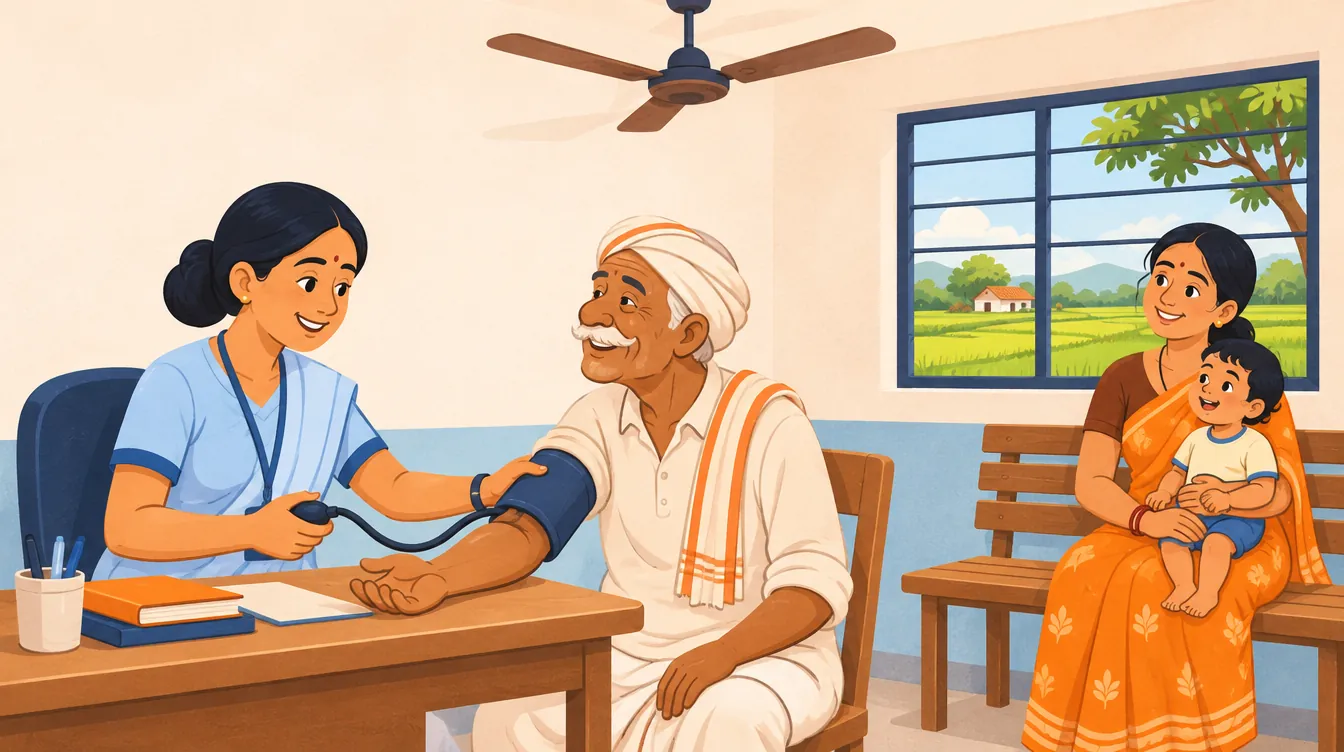
If you are weighing a Health ATM for an Ayushman Arogya Mandir, start with the scheme itself. Ayushman Arogya Mandirs (AAMs), earlier called Ayushman Bharat Health and Wellness Centres, are existing Sub Health Centres and Primary Health Centres upgraded to offer comprehensive primary care close to people's homes. They are the first component of Ayushman Bharat, which originally set a target of 1.5 lakh centres.
- AAMs operational
- 1,80,906 (PIB, 31 Oct 2025)
- Hypertension screenings under NP-NCD
- 38.79 crore (PIB, to 31 Oct 2025)
- Diabetes screenings under NP-NCD
- 36.05 crore (PIB, to 31 Oct 2025)
- Teleconsultations at AAMs
- 41.14 crore (PIB, 31 Oct 2025)
Each centre is meant to deliver 12 packages of primary care, which include reproductive and child health, communicable diseases, non-communicable diseases (NCDs), and palliative and elderly care. Screening, essential medicines and a defined list of tests are free to users. Our guide to Ayushman Arogya Mandirs and their services explains the packages in more detail.
How NCD screening works at an AAM
NCD screening at AAMs runs under the National Programme for Prevention and Control of Non-Communicable Diseases (NP-NCD), renamed from NPCDCS in 2023. Its population-based screening, launched in 2016, covers everyone aged 30 and above for five conditions: hypertension, diabetes, and cancers of the mouth, breast and cervix.
- ASHAs list the eligible population and fill a Community Based Assessment Checklist (CBAC) to gauge each person's risk.
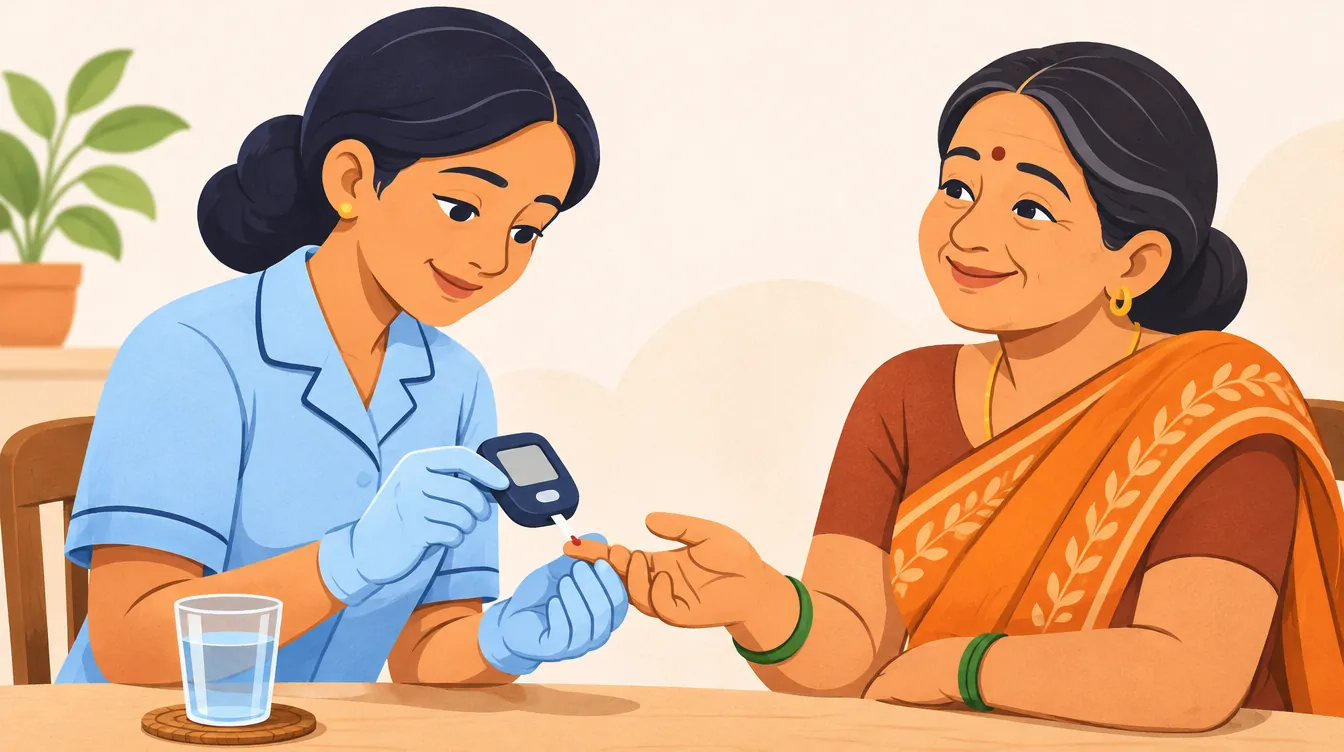
- People are screened at the AAM: blood pressure and blood sugar, plus oral, breast and cervical checks by trained staff. Programme guidance suggests a VIA test for cervical cancer once every five years for women aged 30 to 65.
- Anyone who screens positive is referred to a medical officer at the PHC or a higher facility.
- People who are confirmed with hypertension or diabetes get treatment, free medicines and regular follow-up through the community health officer (CHO), ANM and ASHA.
The scale is large. By 31 October 2025 the NP-NCD portal recorded 38.79 crore hypertension and 36.05 crore diabetes screenings at Sub Health Centres and PHCs, including AAMs. Large numbers also mean long queues, paper registers and repeat measurements, which is where technology can help.
How the centres are funded
AAMs are run by state governments, mainly with National Health Mission (NHM) grants. To strengthen primary care infrastructure in rural and urban areas, the Centre has added two more funding streams: the PM-Ayushman Bharat Health Infrastructure Mission (PM-ABHIM) and health grants under the XV Finance Commission.
NHM's Free Diagnostics Service Initiative sets a free test menu for each level of care, including 14 tests at Sub Centres and 63 at PHCs. For outside organisations, the practical point is simple: decisions on equipment for a centre rest with the state health department and district health society. Any kiosk project has to fit their plans, not run alongside them.
Where a Health ATM fits, and where it does not
A Health ATM is a self-service screening kiosk. Used well, it can take routine measurement off the staff's hands so they have more time for counselling and follow-up.
- Faster routine checks: blood pressure, blood sugar, weight, height, BMI and SpO2 are measured and recorded digitally, so nobody has to copy them into a register.
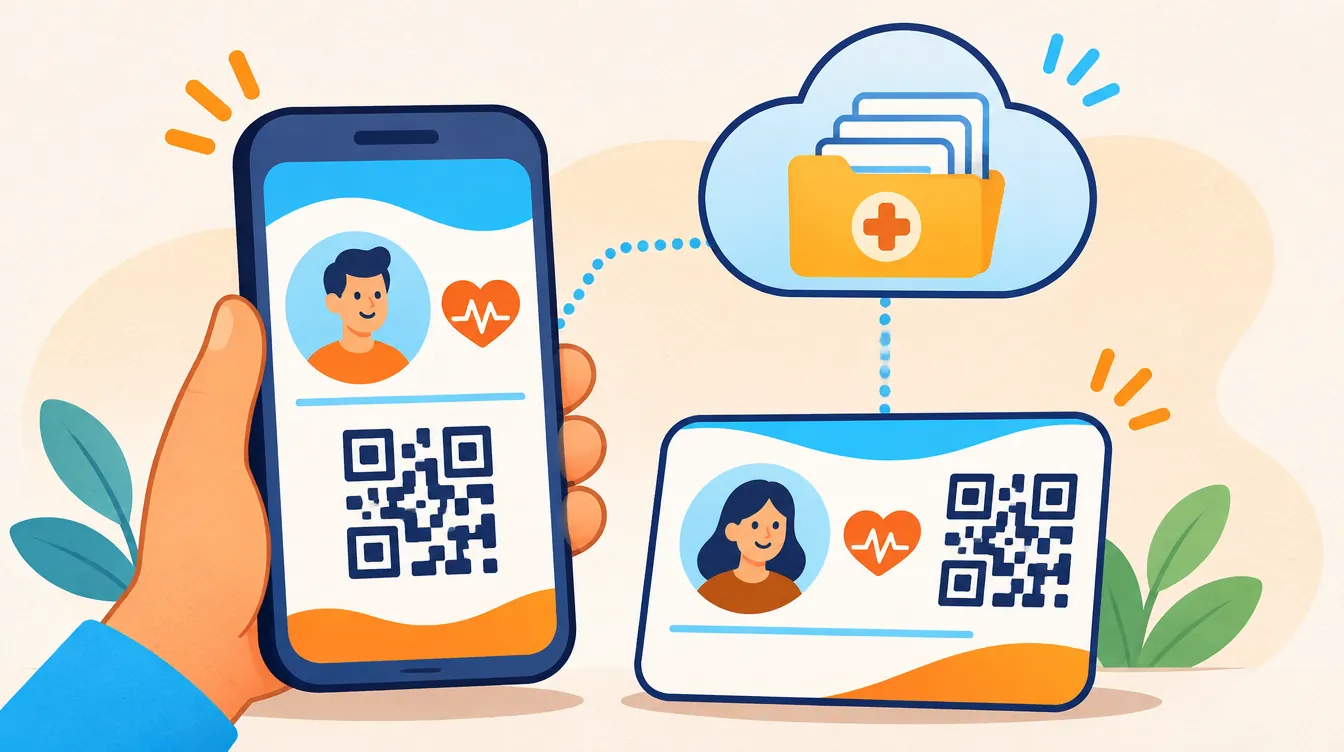
- Records linked to ABHA: results can be linked to the person's Ayushman Bharat Health Account. PIB reported over 93 crore ABHA accounts in July 2026, so many visitors will already have one. See how ABHA integration works on a kiosk.
- Doctor review on video: AAMs already use teleconsultation widely, and a kiosk can put readings in front of a doctor during the call.
- Patchy connectivity: a kiosk that works offline and syncs later suits rural centres.
- Wider test menus: larger models add tests such as lipids, HbA1c or CBC, if the state decides it wants them.
A kiosk does not replace the CBAC, the oral, breast and cervical checks done by trained staff, or the CHO's follow-up. Kiosks screen and measure; a doctor reviews the results and decides on care. Anyone with chest pain, breathlessness or signs of a stroke should call 112 or 108 at once.
Questions to settle before placing a kiosk at an AAM
State officials, CSR teams and NGOs who want to support AAMs should agree on these points before anything is bought:
- Approval: does the state NHM or the district want a kiosk at this centre, and who signs off?
- Data flow: how will readings reach the person's ABHA-linked record, and how will the centre report them in the NP-NCD system? Agree this with the district in writing.
- Operators: who guides users at the kiosk: the CHO, an ANM or a dedicated operator?
- Consumables and service: who pays for test strips and reagents, and what do the warranty and uptime terms cover?
- Privacy: where is the data hosted, and does consent follow the DPDP Act 2023?
- Funding route: a government buyer will usually go through GeM (see our GeM procurement guide). A company has to check the project against its CSR policy (see Health ATMs for CSR projects).
How Cloudspital supports AAM-linked screening
Cloudspital makes AI Health ATMs at its own facility in Greater Noida. It is a DPIIT-recognised startup and a GeM OEM vendor, with 1,500+ units in government installations across India. The CPL-HA range runs from 48 to 170 tests, so a Sub Centre-level AAM and a busy PHC-AAM can each have a model that suits them.
Each kiosk is voice-guided in English, Hindi and regional languages. It works offline and syncs later, integrates with ABHA and ABDM, and sends reports by print, SMS and WhatsApp. A doctor reviews results on video and can issue an e-prescription. Data is hosted in India, in line with the DPDP Act 2023. Service terms include a 5-year comprehensive on-site warranty, 95% quarterly uptime, a 24-hour response time and spares for 7 years.
Next step: list the AAMs you want to support, along with their footfall and connectivity, then compare them against our Ayushman Arogya Mandir kiosk options. When you are ready, book a demo or request a written quote.
Sources
- Update on Ayushman Arogya Mandir (AAMs), Press Information Bureau, Ministry of Health and Family Welfare
- Ayushman Bharat Digital Mission: India's Digital Health Backbone (6 July 2026), Press Information Bureau
- National Programme for Prevention and Control of NCDs: Training module for programme managers, National Health Mission, MoHFW
- Ayushman Arogya Mandir and India's progress toward Universal Health Coverage: A narrative review, PubMed Central
How this article was made: drafted with AI assistance, checked against the sources above, and read and approved by the Cloudspital team before publishing. It is general information, not medical advice.