
Why the three names get mixed up
In a tender meeting, a CSR review or a hospital board discussion, you may hear 'health kiosk', 'Health ATM machine' and 'telemedicine kiosk' used for the same box. Sellers often use the terms loosely too. This matters because the name on a proposal shapes the specification and the budget line. It also shapes what the community actually gets.
The simplest approach is to ignore the label and ask two questions: what does the unit measure on its own? and how does a doctor see the results? The answers put almost any product into one of three groups. For a fuller introduction, see our Health ATM kiosk guide.
What each term usually means
Health kiosk
This is the broadest term. It covers any self-service or assisted station where people check something about their health. That could be a weight and BMI stand, a blood pressure booth, a touch-screen information point or a full screening unit. Some health kiosks have no medical devices at all.
Health ATM machine
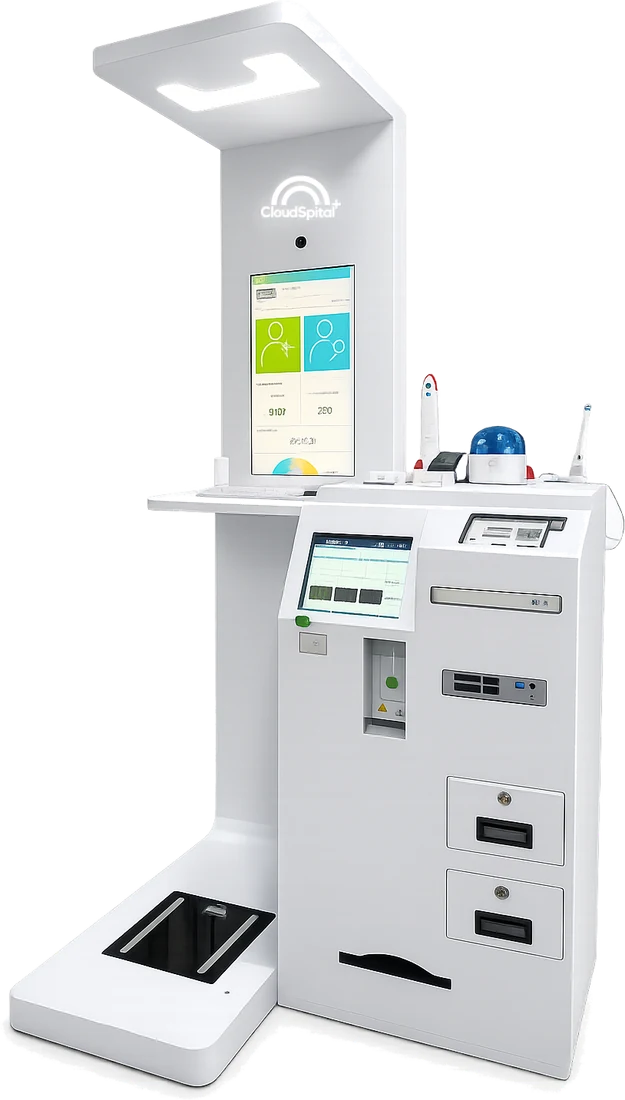
A Health ATM is a health kiosk built around a set of integrated medical devices. A trained operator or the on-screen guide takes the person through vitals such as blood pressure, pulse, oxygen saturation, temperature, weight and height. Depending on the model, it can also run point-of-care blood and urine tests, an ECG, or eye and hearing checks. All the results go into one report, which can be printed or sent to a phone. The Health ATM screens and measures. A doctor reviews the results and decides what they mean.
Telemedicine kiosk
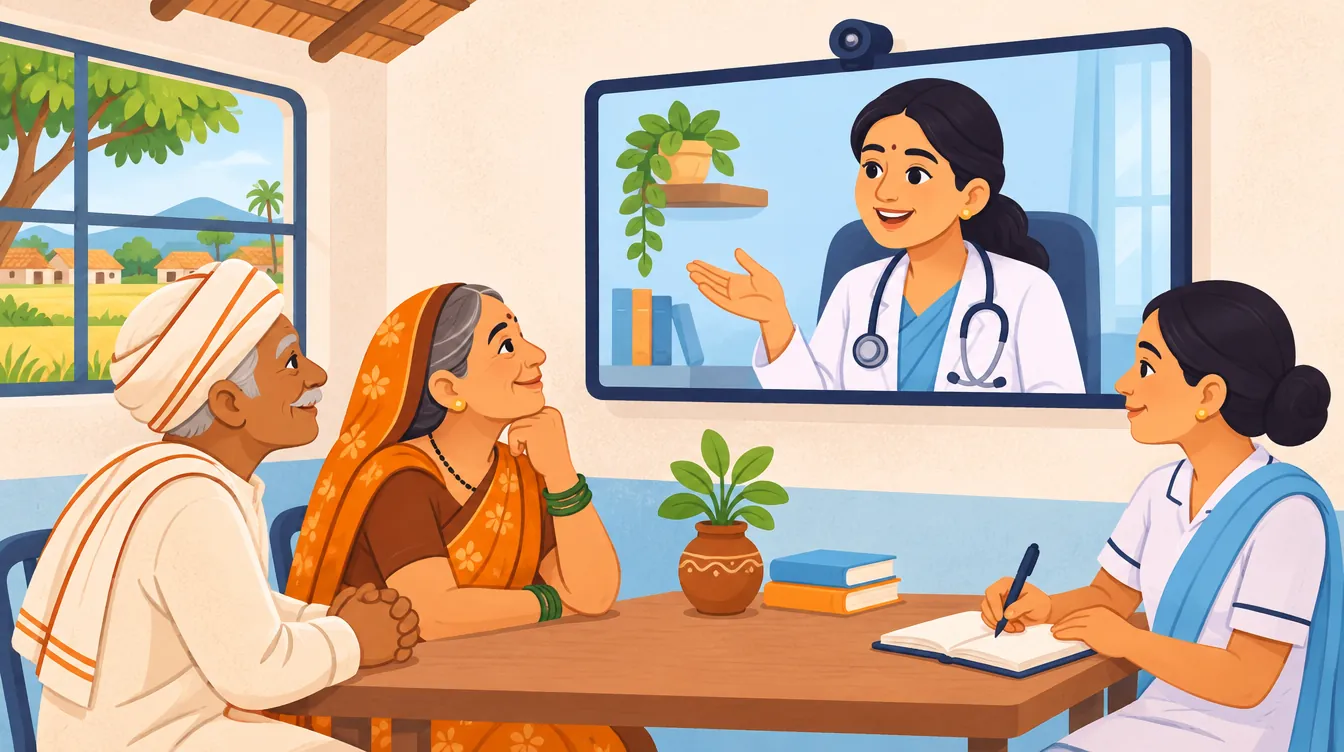
A telemedicine kiosk is built mainly for video consultations. It has a screen, a camera, a microphone and a link to a doctor, and sometimes a few basic devices such as a BP monitor or thermometer. Its strength is quick access to a doctor. Its limit is that the doctor often has few measured readings to work with.
Many modern units combine the last two. These are Health ATMs that take measurements first and then connect the person to a doctor on video, who sees the readings during the call.
Health kiosk vs Health ATM machine vs telemedicine kiosk, side by side
When you compare proposals, check these points instead of the product name:
- Tests on board: a few vitals, or a menu of dozens of parameters including blood tests. Ask for the full list. Our page on Health ATM tests and parameters shows what a typical menu covers.
- Doctor link: none, video only, or video with the person's readings in front of the doctor.
- Report: printed, sent by SMS or WhatsApp, and whether it can be linked to a health record.
- Staffing: fully self-service, or run by a trained operator, nurse or health worker.
- Consumables: blood tests need strips, cartridges or reagents, so you need a plan for restocking them.
- Connectivity: whether the unit keeps working when the internet drops and syncs the data later.
- Service: who repairs it, how quickly, and for how many years.
For a closer look at video-first units compared with measuring kiosks, read telemedicine cart vs health kiosk.
Where each fits in Indian healthcare
India already runs teleconsultation at a very large scale. According to the Ministry of Health, eSanjeevani, the national telemedicine service, crossed 50 crore teleconsultations in October 2026. Ayushman Arogya Mandirs offer teleconsultation as well as screening for common non-communicable diseases.
- eSanjeevani teleconsultations
- Over 50 crore (PIB, October 2026)
- Ayushman Arogya Mandirs operational
- 1,81,873 (PIB, as on 30.11.2025)
- Teleconsultations at Ayushman Arogya Mandirs
- 41.93 crore (PIB, as on 30.11.2025)
- Hypertension screenings at SHCs and PHCs
- 38.79 crore (NP-NCD portal, till 31.10.2025)
These numbers point to a practical gap. More and more doctors are available on video, and screening is already a routine part of primary care. The quality of a remote consult often depends on whether the doctor has reliable readings to look at. That is where a Health ATM that takes measurements adds value over a video-only station.
- A basic health kiosk suits a low-cost awareness point where a few vitals are enough, such as an office lobby, a gym floor or a pharmacy counter.
- A telemedicine kiosk suits sites where a nurse or health worker already takes measurements and the real shortage is a doctor's time.
- A Health ATM machine suits places where people need both. Examples include PHCs, Ayushman Arogya Mandirs, village CSR projects, factories, colleges and housing societies. There, many tests and a doctor's review in one visit save repeat trips.
Questions to settle before you write the specification
- Which conditions do you want to screen for, and which tests do they need? Start from the programme's goal, not from a brochure.
- Who will run the unit each day, and what training will they get?
- Which doctors will review the results: your own, a state teleconsultation service, or the supplier's panel?
- Where will reports and records go, and how will consent be recorded? Check that data is stored in India and handled in line with the DPDP Act 2023.
- What happens when someone has a worrying reading? Write down the referral path to the nearest PHC, CHC or hospital.
- How will consumables be bought and restocked, and who pays for them after the first year?
- What are the service terms: response and repair times, uptime, and how long spares will be available?
A common mistake is buying on the name alone. A unit called a 'Health ATM' in one proposal may offer only a handful of tests, while a 'health kiosk' in another may offer a long test menu. Always get the test list, the doctor link and the service terms in writing, and compare those.
How Cloudspital's Health ATMs fit these definitions
Cloudspital was founded in 2020 and builds AI Health ATMs at its own facility in Greater Noida, Uttar Pradesh. In the terms above, they are Health ATM machines with a telemedicine link built in. The person is measured first. Then a doctor reviews the results on video and can issue an e-prescription.
- Range: 10 CPL-HA models, running from 48 to 170 tests and parameters. The flagship Arc Max (CPL-HA-10) offers 170 tests in 18 clinical panels with 22 integrated medical devices, including a CBC with 3-part differential, liver and kidney function and sickle cell screening. The AI Health Pod is a walk-in booth with the same 170-test menu.
- Face scan: a 30-second, contactless AI face scan gives 28 wellness indices using clinically validated technology. These indices are for awareness; a doctor interprets anything that needs attention.
- Reports and records: reports print at the kiosk and reach people by SMS and WhatsApp. The kiosks also offer ABHA and ABDM integration, cloud records and a dashboard.
- Ready for the field: the kiosks work offline and sync later. They are voice-guided in English, Hindi and regional languages, and data is hosted in India in line with the DPDP Act 2023.
- Service: delivery in 10 days, installation in 7 days, a 5-year comprehensive on-site warranty, 95% quarterly uptime, 24-hour response, 72-hour resolution and spares for 7 years.
More than 1,500 units are in government installations across India. You can compare every model and download the catalogue on the products page. To see how the pieces fit together, read our complete Health ATM kiosk guide. Cloudspital does not publish prices. For a written quote or a demo for your site, book a demo or request a quote.
Sources
- E-Sanjeevani Crosses 50 Crore Teleconsultations, Strengthening Access to Healthcare Across the Country, Press Information Bureau, Ministry of Health and Family Welfare
How this article was made: drafted with AI assistance, checked against the sources above, and read and approved by the Cloudspital team before publishing. It is general information, not medical advice.